Judging a seller and a garment when all you have is an album
No reviews, no sales counts, no store ratings. What you can still check about a seller and an item from an album, plus sizing in centimetres and a last pass before paying.
Reading the seller from what the album shows
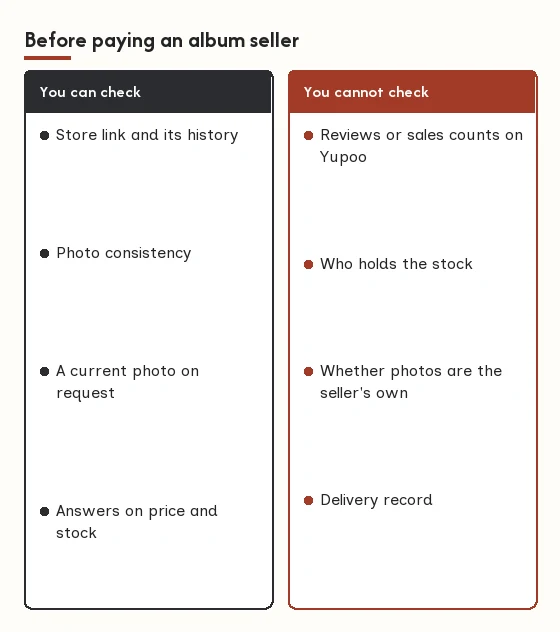
Yupoo has no reviews, no sales counts and no store ratings, so the usual seller signals are missing. What you can check sits in the album itself and in how the seller answers, through the agent’s buyer, before you pay.
- The contact page. A store link gives you a marketplace store with its own history and ratings to read. Chat contacts alone give you nothing to read.
- Consistency. Do the photos share a background and lighting, as photos taken in one place would? A mix of styles suggests pictures gathered from elsewhere.
- Detail on request. Ask the seller, through the buyer, for a current photo or a measurement. A seller who sends one quickly is easier to deal with than one who repeats the album text.
- Straight answers on price and stock. A price that changes on every question is a cost you will carry.
None of this rates the seller, and this site does not rate sellers. It tells you how much you will be able to check before your money goes.
Choosing the item from photos
Choosing an item from an album is choosing from photos and a few lines of text, so pick things whose quality shows in photos. Plain outerwear, knitwear, denim, shirts and household objects photograph honestly: you can see the cloth, the seams and the shape. Items whose appeal rests on a mark or a name are another matter, and the risks page explains why agents and customs treat them differently.
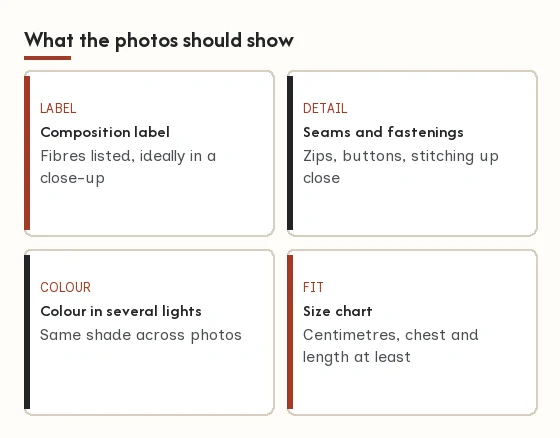
Look for a photo of the composition label, which lists the fibres; for close-ups of seams, zips and buttons; and for the same colour across several photos taken in different light. If the album has a size chart, the item is usually easier to get right.
Plain items are also easier to compare when the warehouse photos arrive. A navy overshirt either matches the album or it does not.
Fit, sizing and Chinese labels
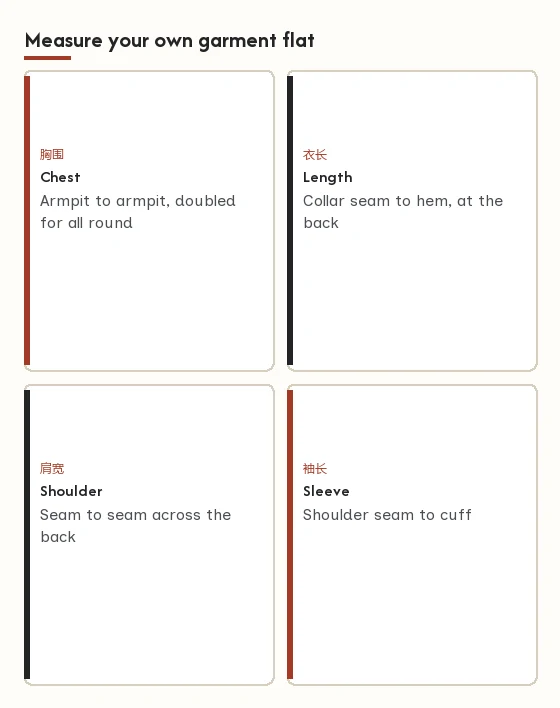
Size letters on Chinese labels tend to run small against European and American sizing, so ignore the letter and use centimetres. Lay a garment you already own flat, measure it the way the chart does, and pick the size whose numbers are closest.
Album charts are usually in Chinese. The words in the table cover most of what you will see. Hand measurements commonly differ by one to three centimetres from the chart, so treat a chart as a guide and ask the warehouse to measure if a centimetre matters.
| Chinese | Meaning |
|---|---|
| 衣长 | Garment length |
| 胸围 | Chest, measured all round |
| 肩宽 | Shoulder width |
| 袖长 | Sleeve length |
| 腰围 | Waist |
| 臀围 | Hip |
| 裤长 | Trouser length |
Before you pay: a short list of checks
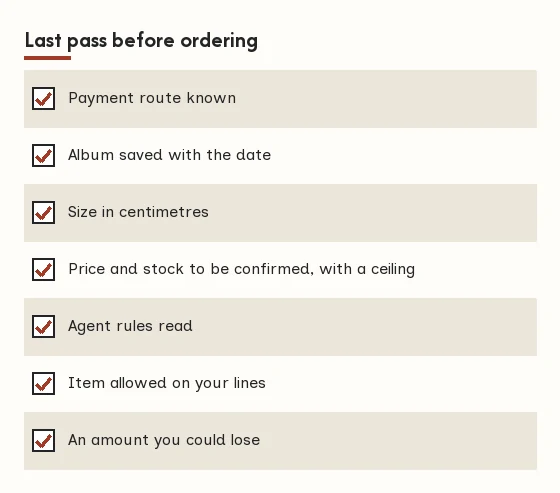
A last pass before the order goes in catches most avoidable mistakes. It takes five minutes and saves weeks.
- You know the payment route from the contact page.
- You saved the photos, title, description, folder path and price, with the date.
- Your size is written in centimetres, not as a letter.
- The notes ask the buyer to confirm price and stock, with a ceiling in yuan.
- You have read the agent’s rules for third-party or hand-filled orders.
- The item is something the shipping lines to your country carry.
- The amount is one you could afford to lose.
Watch out for the order that feels urgent. Albums are always there tomorrow, until they are not; a rushed order is the one most often wrong.
Items that travel badly
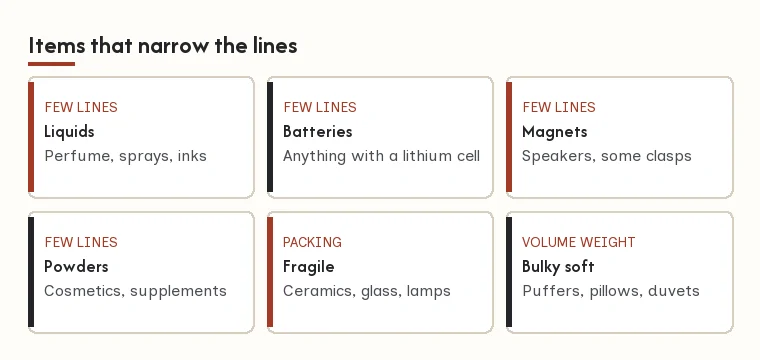
Some album items are easy to buy and hard to ship. Liquids, powders, batteries and magnets are refused by many lines or limited to a few; perfume and anything with a lithium cell are the usual examples. Ceramics and glass need extra packing and still break. Bulky soft goods, puffers and pillows above all, cost more by volume than by weight.
Check the shipping restrictions for your country before you order, not after the item reaches the warehouse. An item that no line will carry has to be returned to the seller, if the seller allows it, or abandoned.