
From a Yupoo album to a parcel at your door
The route one album item takes: the contact page, the agent order, the purchase, the warehouse photos and the parcel. Worked through at the end with a plain navy overshirt from an invented album.
The contact page sets how you can pay
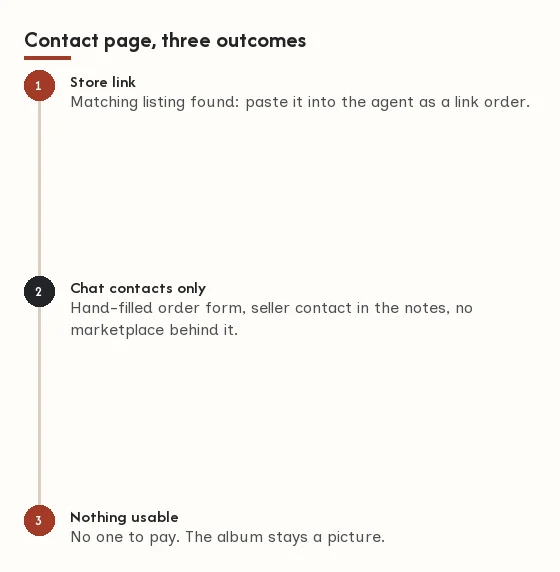
Start on the album’s Contact tab, not on the photos. What it lists decides everything that follows, and there are only three outcomes.
- A store link. Weidian or Taobao, usually. Find the listing that matches the album item and you have an ordinary marketplace product: a price per option, a stock count and a link an agent can read.
- Chat contacts only. Ask the agent whether it can contact this seller and whether a matching marketplace listing is available. If the accepted route is manual, put the agreed item, price and contact details into the agent’s form and read its cancellation and return conditions.
- Nothing usable. Without a verifiable contact or matching listing, you do not yet have an order the agent can safely identify. Find those details before paying; an album cover alone is insufficient.
Write down which outcome you have before you open an agent’s site. It tells you which form to use and how much protection you are giving up.
Two ways in: a pasted link or a hand-filled form
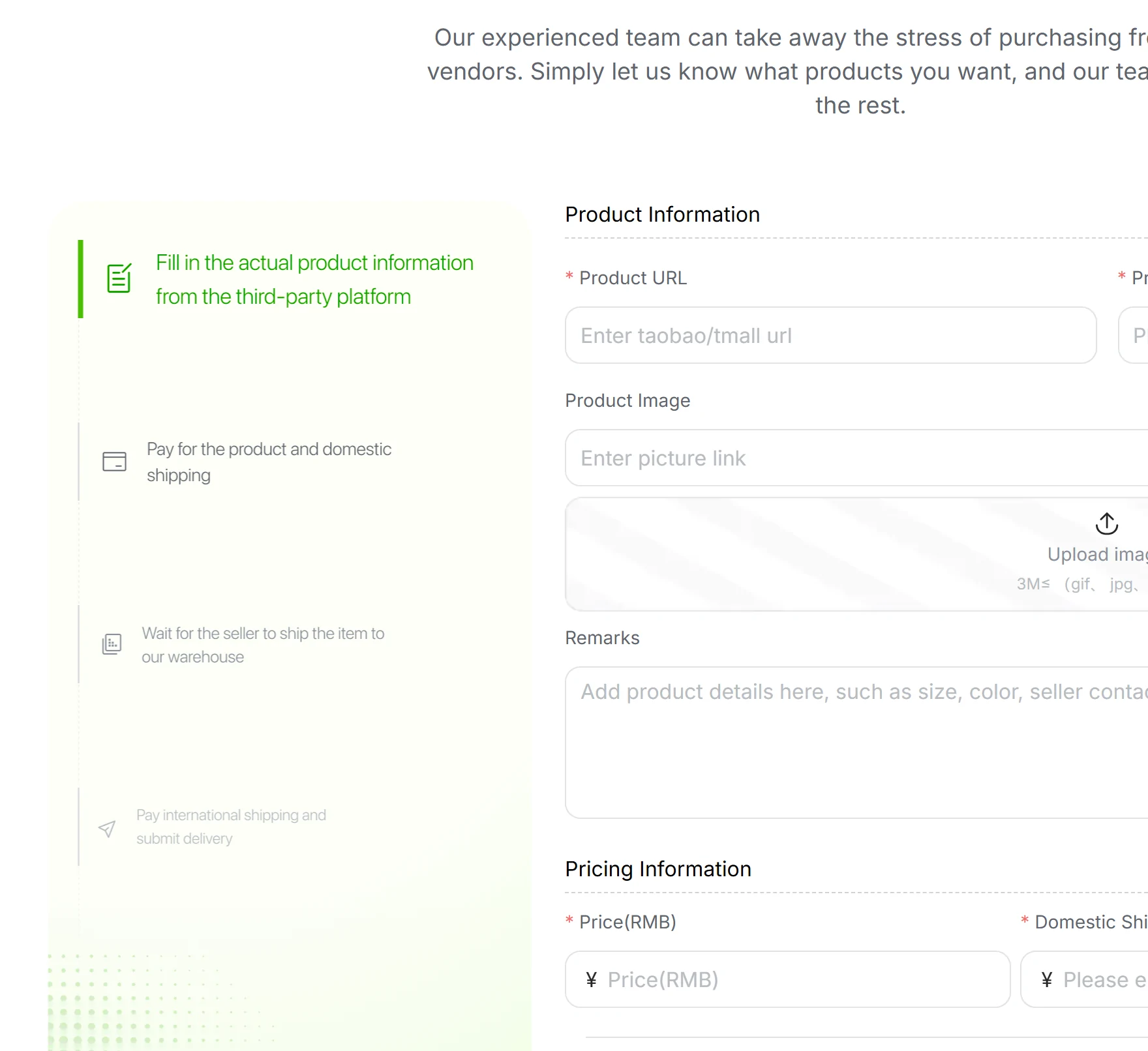
Every agent has a search box that reads marketplace links. Paste a Taobao, Tmall, 1688 or Weidian listing and the agent fills in the title, the options and the price for you. Paste a Yupoo album address and most agents return nothing useful, because the page has no price, no options and no checkout for them to read.
For that case each agent keeps a manual form under its own name. LoongBuy’s older Chinese help calls it the purchase order form, 代购单; Kakobuy and Lovegobuy call it Fill & Buy; CSSBuy calls it Expert Buy; Basetao calls it self-help ordering. Superbuy takes third-party orders and treats them as accepted once they show Processing within an hour.
Lovegobuy is the exception worth knowing: its announcement says that after you copy a Yupoo product link and open its site or app, the request is recognised automatically and sent to the Fill & Buy flow. You still check the fields it fills.
From a saved photo to an agent’s order form
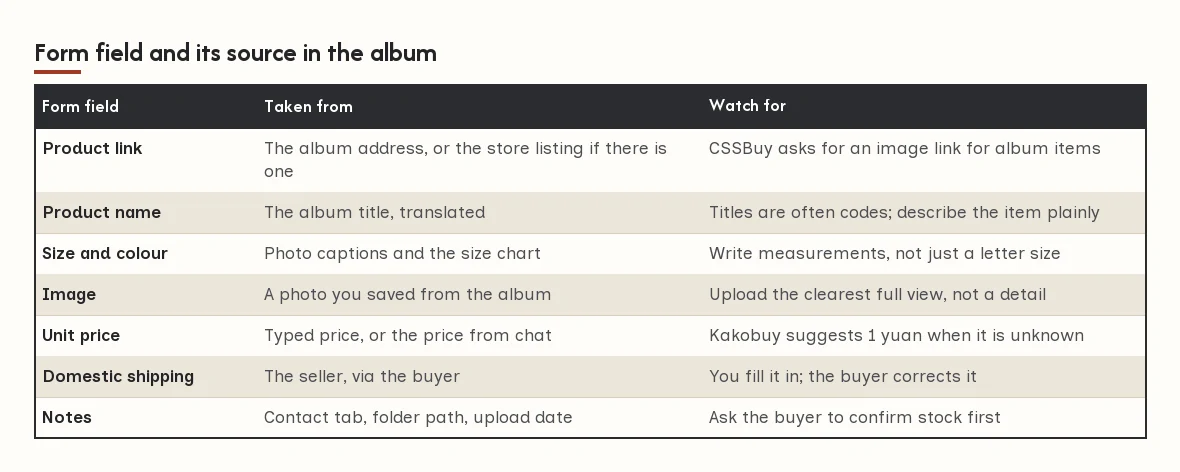
A manual form asks for the same handful of things at every agent. Each one comes from a specific place in the album, which is why saving the album before you start matters. The table is the map we use; the field names differ a little between agents.
Save first, then fill
Save the photos you will rely on, the album title and the folder path to your own device, with the date. Albums get locked, edited and taken down, and the warehouse compares against what you sent.
Keep the notes field short
One line each: the seller’s contact, the folder path, the size you want in centimetres, and a request to confirm price and stock before paying. Buyers read short notes.
Make the request complete enough to check later
For a plain overshirt, retain the album item reference, the seller or shop link, the chosen colour and size, the stated material, the measurement chart and the quantity. Add the agreed price and domestic delivery information where available. If a detail is unknown, ask the seller or agent before submitting a paid instruction. A vague remark such as same as photo can leave several possible versions open.
Read the agent’s summary after it has interpreted the link or manual form. Compare the selected specification and total with your saved request. If the price or stock has changed, decide whether to accept the change instead of assuming the original album entry is still available. Keep the seller discussion and the agent order reference connected.
The first payment concerns buying the goods and the relevant local charges. The seller then delivers to the warehouse, where you review the received item. International shipping is a later choice with its own costs and restrictions. Choosing an agent such as LoongBuy or another supported service should depend on that whole process, including the actual manual-order terms, rather than the presence of an order form alone.
Paying, buying and the wait for the seller
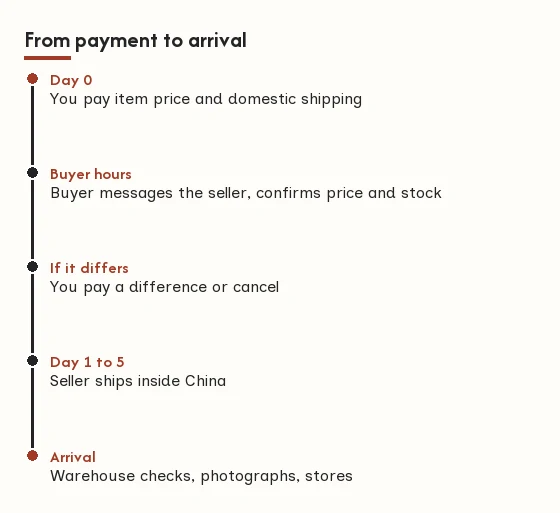
You pay the agent for the item price and the domestic shipping you entered. Then a buyer picks up the order. On a manual order that means a message to the seller: is it in stock, what does it cost today, when will it ship. If the answers differ from your form, the agent asks you to pay a difference or to cancel.
Speed depends on the agent’s buyer hours. Kakobuy lists the buyers for Weidian, Yupoo and Xianyu items as working Monday to Sunday, 9:00 to 18:00 China time, and sells a priority purchase for 5 yuan that is handled within four buyer working hours. Superbuy counts an order from Yupoo and similar platforms as accepted once its status turns to Processing within an hour.
After purchase the seller ships to the warehouse by domestic courier. Kakobuy’s tutorial puts that at three to five days; a holiday notice on the album homepage can stretch it. LoongBuy’s English FAQ lists the same sequence: submit the order, pay, wait for the seller, then warehouse inspection and storage.
Arrival at the warehouse
When the parcel reaches the agent, staff open it, check that the item matches the order on the visible basics and photograph it. That is the moment the album earns its keep: you now hold two sets of pictures, the seller’s and the warehouse’s, and you can set them side by side.
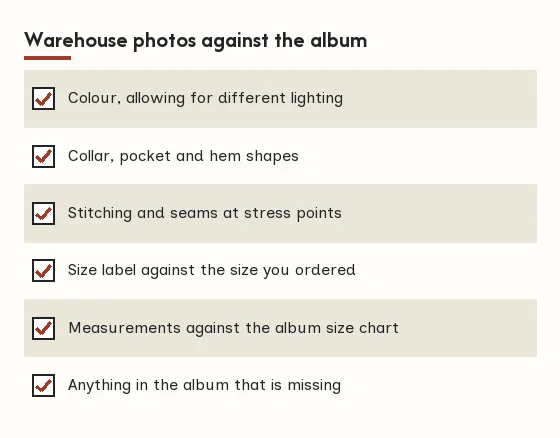
Look at colour under the warehouse lighting, the shape of collars and pockets, the stitching and the size label. If the album had a size chart, ask for a measurement of the same two or three dimensions. If something is wrong, this is the time to ask for an exchange or a return, inside the seller’s rules and the agent’s deadlines.
The warehouse photos and shipping page covers what the standard check includes, what it never includes, and how to read the photos against the album.
Packing several orders into one parcel
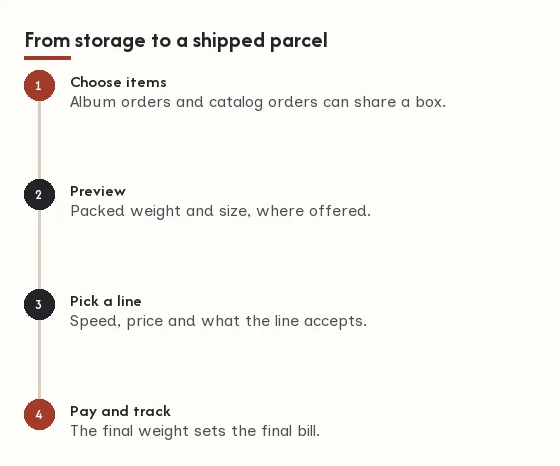
Items wait in storage until you ask for them to be shipped. Free storage runs from 60 to 120 days at the agents on this site; LoongBuy’s FAQ says goods usually get 90 days free after warehousing and can stay up to 180. Most buyers let a few items gather and ship them together, because international shipping is charged by weight and by size.
Choose the items, ask for a packing preview where the agent offers one, pick a shipping line and pay the international shipping. LoongBuy calls its preview a parcel rehearsal: the warehouse packs the box first so you see its real weight and the line prices before committing. The final bill follows the packed weight, so estimates are often adjusted up or down.
Slow lines, such as rail or sea, run under different rules for delays and losses than air lines do. Read the line notes before choosing.
A worked example with a plain navy overshirt
Here is one order walked through end to end. The album and seller are invented; the steps are the ones described above.
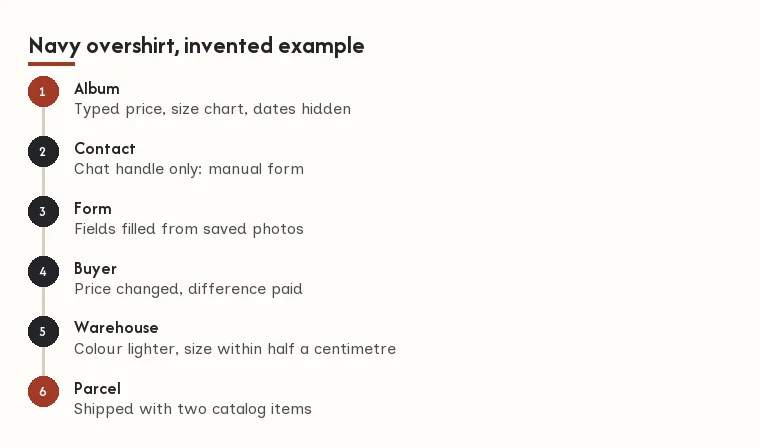
- The album shows a navy cotton overshirt in eight photos, the last one a size chart. The title carries a price of 168 yuan. Upload dates are hidden and the homepage notice says albums update daily.
- The Contact tab lists a single chat handle and no store. That makes it a manual order. The photos, the title, the folder path and the chart are saved to a laptop with the date.
- The order goes in through the agent’s manual form: album address as the link, a plain name instead of the title code, size written as chest 58 cm and length 74 cm, 168 yuan as the price, 10 yuan as a guess for domestic shipping, and a note with the handle and a request to confirm stock.
- The buyer reports back the next working morning: in stock, now 175 yuan, shipping 8 yuan. The difference of 5 yuan is paid.
- Four days later the warehouse photos arrive. The navy reads slightly lighter than in the album, the pockets and stitching match, and a measurement shows chest 57.5 cm. The shirt is kept.
- It waits in storage for two catalog items, then ships in one parcel on an air line chosen after a packing preview.
In this illustrative order, the seller contact established how to buy and the warehouse comparison checked what arrived. The other steps still matter: selected options, payment terms, packing and shipping restrictions can change the outcome.
Track, receive and check the parcel
Save the parcel number and follow the carrier as well as the agent’s dispatch record. A long gap between scans is not proof of loss; ask support about the line’s investigation process and deadline when the status becomes unclear.
At delivery, photograph damage before discarding the wrapping. Compare quantities and variants with the order, keep the shipping label and send support a concise description with the relevant photos. An album screenshot shows what you expected; the order, payment and warehouse records connect that expectation to the item actually purchased.
This is an editorial buying workflow across several agents, not a single agent’s official numbered tutorial. Use the actual form and current terms in your account at each decision.